


Dana was fifty-one when she sat across from me with her hands folded so tightly in her lap that her knuckles had gone white. Her grown son had moved back home three years earlier “just for a few months” while he got back on his feet. He had not gotten back on his feet. He slept until noon, left his dishes in the sink, spoke to her with a sharpness that would have made a stranger gasp, and asked her for money every few weeks in a tone that suggested she owed it to him. When I asked Dana why she kept giving, she said the thing I have heard a thousand times in a thousand different rooms.
“You don’t understand what he’s been through,” she said. “If you knew his story, you’d understand why he is the way he is.”
She was right. Most people who wound the ones who love them have a story. But Dana had taken his story and turned it into a permission slip. She understood his pain so completely that she had stopped requiring him to do anything about it. She felt his struggle so deeply that she had agreed to struggle in his place. She had become the shock absorber for a life that was not hers to cushion.
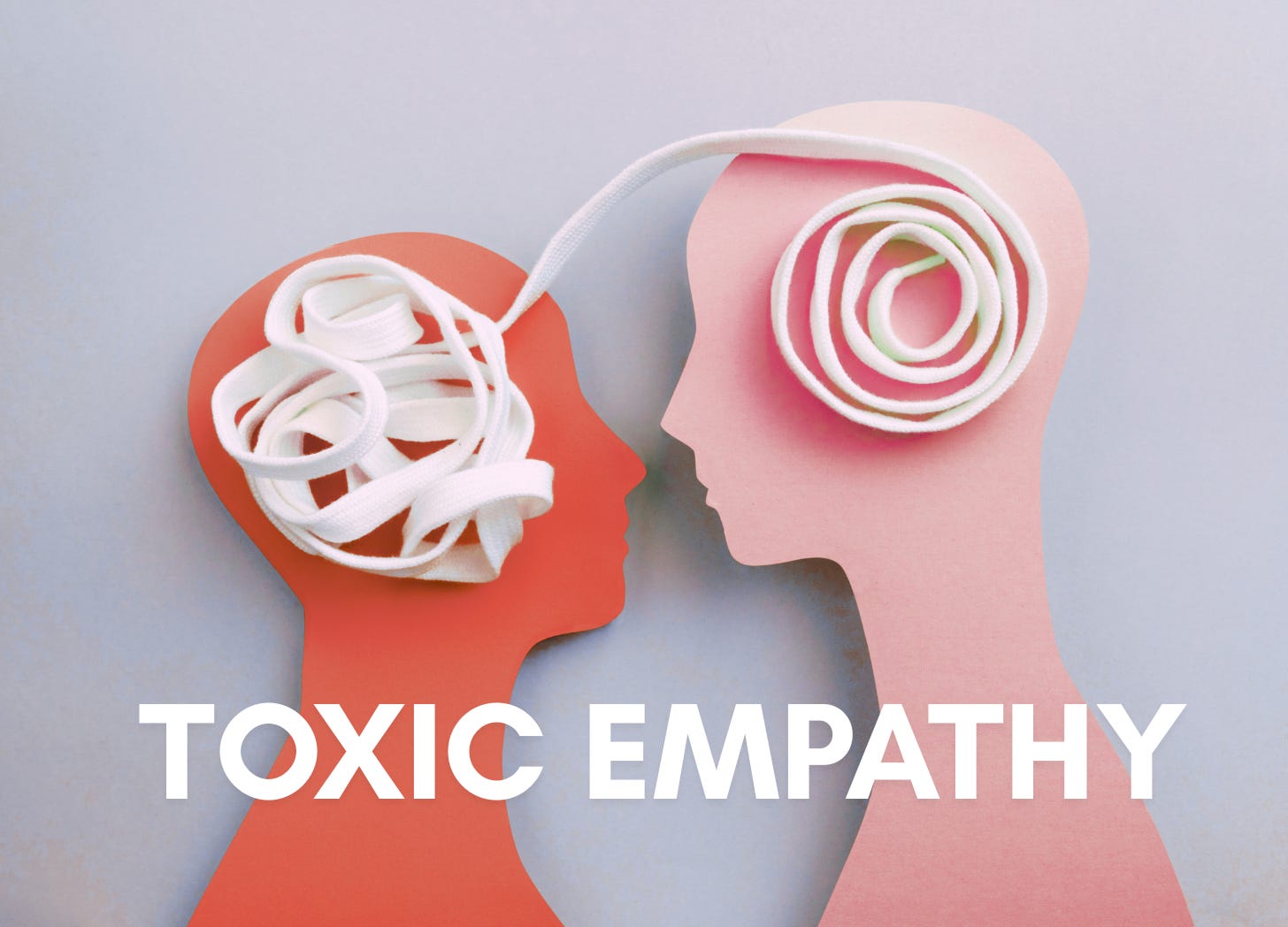
That is toxic empathy.
What Toxic Empathy Actually Is
Empathy is one of the most powerful strengths a human being can carry. It lets you understand another person, connect with them, sit with them in their pain instead of leaving them alone in it. It lets you love deeply and perceive accurately and act with real compassion. Your empathy is not the problem. Your empathy is a gift.
But a gift without boundaries wounds. And empathy, when it loses its boundaries, does something quiet and dangerous. It begins to distort.
It starts as feeling with someone. That is healthy. That is connection. Then it slides into feeling for them, where their emotion becomes your emotion and you cannot tell anymore whose feeling you are carrying. Then it slides further, into feeling instead of them, where you do the grieving and the worrying and the fixing that they should be doing for themselves. And at the very bottom, it slides into the worst place of all, where you feel their consequences while they feel nothing at all. They make the mess. You lie awake. They make the choice. You pay the bill. They cause the harm. You carry the shame.
That is the line. Toxic empathy is not compassion, and it is not kindness, and it is not love, though it wears all three like a costume. Toxic empathy is the reflex to absorb pain that was never yours, to protect people from the natural consequences of their own behavior, and to carry emotional loads that belong on someone else’s back. It is empathy without boundaries. It is empathy without discernment. It is empathy that slowly erases the woman doing the feeling.
If you have ever been wrung dry by another person’s emotions, if you have swallowed your own truth to keep someone else comfortable, if you have taken more responsibility for someone’s healing than they were willing to take themselves, then you already know what toxic empathy feels like from the inside. You have lived there. You may be living there right now.
The Three Things That Turn Empathy Toxic
Healthy empathy is grounded. It keeps its feet on its own floor. Toxic empathy is consuming. It leaves its own floor and moves into someone else’s house and forgets the way home. There are three specific shifts that take a beautiful strength and turn it against the woman who carries it.
The first is over-identification. You do not simply understand what someone feels. You absorb it. Their anxiety becomes the knot in your stomach. Their sadness becomes the weight on your shoulders. You take their pain personally, as though their suffering were an accusation against you. You merge your emotions with theirs until you genuinely cannot tell where you stop and they begin. A friend calls upset, and three hours after she hangs up and goes to bed, you are still upset, carrying a feeling she has already put down. That is not connection. That is a loss of self disguised as love.
The second is compulsive responsibility. Your reflex, before you have even thought about it, becomes the same three sentences on a loop. I’ll fix it. I’ll handle it. I’ll take care of it. Underneath those sentences live beliefs you have never once examined. If they are hurting, I should help. If they are upset, it is my job to calm them. If they suffer a consequence, they will fall apart, and it will be my fault for letting it happen. So you step in again and again until responsibility has quietly replaced equality. A relationship between equals becomes a relationship between a caretaker and a person being carried. And no one ever decided that out loud. It just happened, one rescue at a time.
The third is the most dangerous. Toxic empathy gives moral permission for harm. You allow people to mistreat you because you understand why they do it. You take the disrespect, the moods that swing without warning, the manipulation, the broken promises, the coldness, the cruelty, the lies, and you run every one of them through the same machine. He only acts this way because of his childhood. She only says these things because she’s hurting. He doesn’t mean it, he just gets overwhelmed. You become so fluent in explaining the pain behind the behavior that you stop noticing the behavior is crushing you.
Pain does not excuse harm. Ever. A person can have the most heartbreaking story in the world and still not be allowed to bleed on you for it. Understanding why someone hurts you is not the same as agreeing to letting them hurt you. You can hold deep compassion for what made a person who they are and still refuse to be their whipping post.
The Beliefs Holding It All Up
Every toxic-empathy pattern stands on a foundation of beliefs you absorbed so long ago that you have never thought to question them. They do not feel like beliefs. They feel like facts. They feel like reality. They feel like simply being a good person. Let me drag a few of them into the light, because a belief loses most of its power the moment you can see it clearly.
If I don’t help them, they’ll fall apart. This belief turns you into someone’s life-support machine, and a life-support machine is not allowed to leave the room. It cannot rest. It cannot have needs. It exists only to keep someone else breathing. You were never meant to be a machine.
If I set boundaries, I’m being unkind. This is exactly backward, and it may be the most expensive lie in the whole book. A boundary is one of the most compassionate things you can offer another human being, because it tells them the truth about where they stand and gives them the dignity of carrying their own weight.
Their pain matters more than my peace. This is not humility. Humility does not require you to disappear. This is learned self-erasure, taught to you by someone, somewhere, who benefited from your willingness to vanish.
If I don’t step in, who will? So you become the permanent volunteer for every emotional emergency in every life you touch, on call twenty-four hours a day for a job no one is paying you to do and no one will thank you for.
They’re hurting, so I can’t hold them accountable. And there it is again. Pain does not cancel accountability. The most loving thing you can do for a hurting person is often to expect more of them, not less.
I’m strong enough to handle this. Maybe you are. That is the trap. Your strength has become the reason you keep getting handed loads that were never yours. Strength misused does not build anything. It just lets you carry destruction longer than a weaker woman could.
Where It Always Ends
I wish I could tell you that toxic empathy leads somewhere different for each woman, but it does not. It ends in the same handful of places almost every time, and you may recognize the address.
It ends in emotional exhaustion, a low constant hum of overwhelm that you have lived with so long you have stopped calling it anything. It ends in identity loss, the strange day you realize you no longer know what you want, only what everyone around you needs. It ends in self-neglect, your own feelings filed somewhere at the bottom of a list that never reaches you. It ends in resentment, the bitter math of giving far more than is healthy and receiving far less than you need, even though you swore you would never become resentful. And it ends, finally, in burnout, when your nervous system simply puts down what your willpower refused to.
Dana reached all five. By the time she sat in front of me, she was exhausted and unrecognizable to herself and quietly furious at a son she also deeply loved. The empathy that had once made her a wonderful mother had, without boundaries, made her his enabler. The same gift, pointed in a destructive direction.
Here is what I told her, and what I am telling you. The goal is not to feel less. You are not here to become hard. The goal is to feel with your feet still on your own floor. To love people without dissolving into them. To understand a person’s pain and still hand it back to them, and say, this is yours to carry, and I believe you can.
That is not the death of your empathy. That is its healing. And it begins the moment you can name the thing for what it is.